Showing posts with label forbidden fruit. Show all posts

Wednesday, April 24, 2013

Previous Spot Revisited: 1984-85 Suzuki SJ410 Jimny


I first spotted this Suzuki here on April 4, 2013, but spotted it again in the same place. The racing stripes on the bonnet are gilding the lily a bit given that the 1000cc inline four is barely capable of normal freeway speeds, let alone racetrack speeds, and the J.C. Whitney Samurai hardtop looks out-of-place, but this would be an ideal restoration candidate between its condition and its rarity in the continental US. The outline of Hawaii on the back window may hint at where this came from, since unlike the LJ20 and Carry in the 1970s, they were only distributed on Hawaii and other US outlying islands.

Thursday, April 4, 2013

Side Street Find: Datsun 510 Wagon and Suzuki SJ410 Jimny


I spotted this tatty but solid Datsun 510 station wagon whilst carspotting/old-iron hunting in an industrial area near me, it was in front of a warehouse, and appears to be a daily driver.

But what's that behind it? Surely it's a Suzuki Samurai! Still a worthy spotting in uncut condition like this.


Here we have an early 80s Suzuki SJ410 Jimny, a model not sold in the continental US, but distributed on outlying islands like Hawaii, Guam, Puerto Rico and the Mariana Islands. It was the successor to the smaller, lighter-weight, less substantial LJ jeep of the 1970s and differs in numerous ways from the more familiar Samurai. This one is left-hand-drive, evidently has a few aftermarket Samurai bits on it, and appears to be owned by someone who knows what they have. The yellow Oregon plates indicate that it  has been on the mainland since at least 1986 (N numbers on Oregon plates were 1986-1987 only)


Friday, March 8, 2013

Piaggio Ape: The Tiny Truck That Put The World's Working Men on Wheels

(all pictures from Wikimedia Commons)

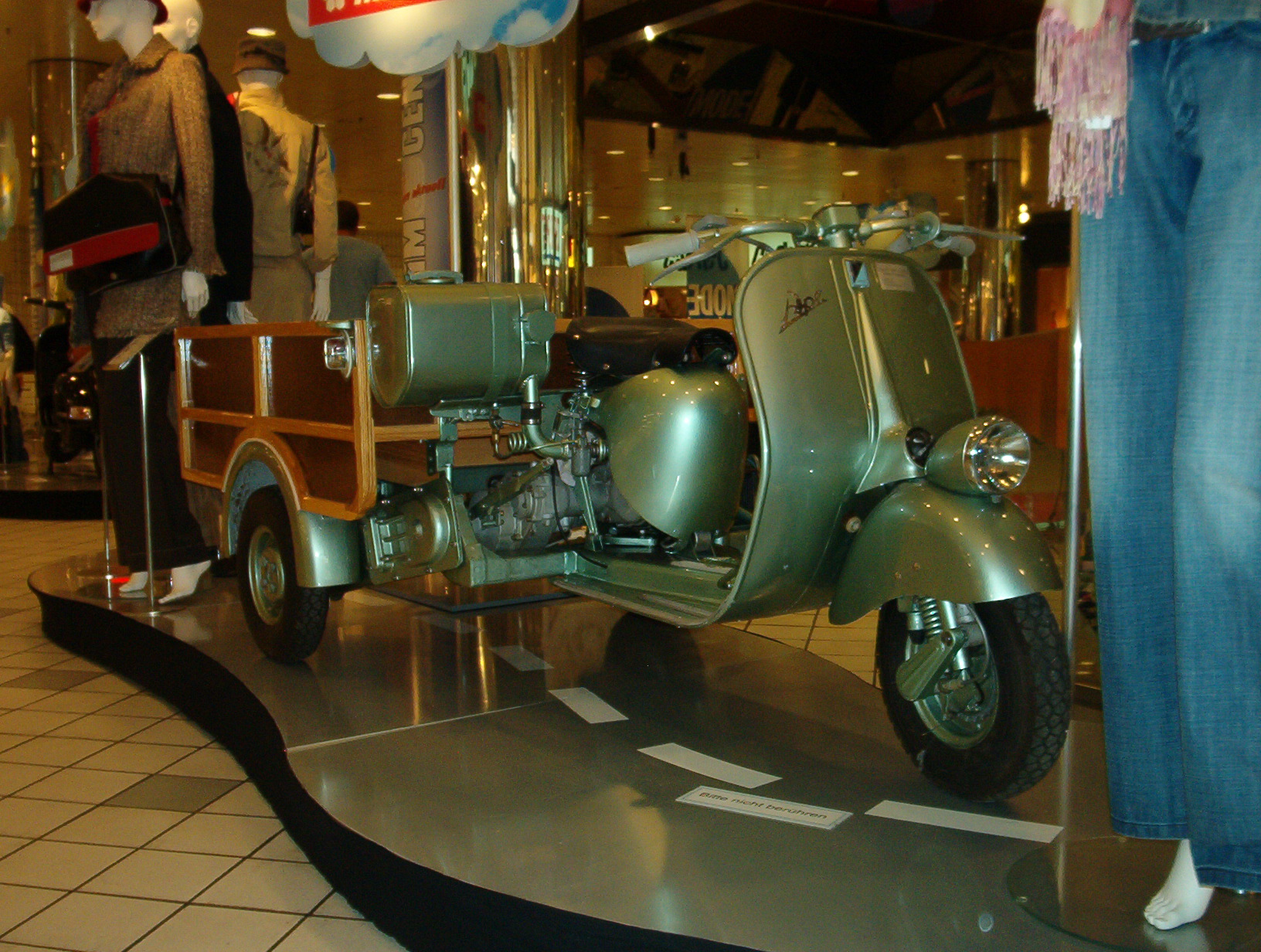
Let's reflect on the years immediately after World War II. While the US and British Commonwealth had their own domestic or locally-assembled light trucks along with countless surplus US military Jeeps, much of the rest of the world relied on horse and wagon or pushcart to conduct business on the ravaged streets of the European continent and the then largely nonmotorized areas of sub-Saharan Africa, the Indian subcontinent and Southeast Asia. Former aircraft manufacturer turned motorcycle maker Piaggio, of Pontadera, Italy, came up with the idea of adding a two-wheeled rear axle, extended chassis and wooden cargo bed to their popular Vespa motorscooter for use in commerce as well as in the postwar reconstruction of Italy.

An immaculately restored Ape A
The vehicle, launched in 1947 and initially called the Piaggio TriVespa but later dubbed Piaggio Ape (pronounced ah-pay and Italian for honeybee, Vespa means wasp and a bee-related name was only natural), was very popular, and updates arrived quickly.

By 1952, the Ape B boasted a 150cc engine, pressed steel cargo bed, and cable-operated gearchange. Styling changed negligibly until the completely new Ape C arrived four years later.

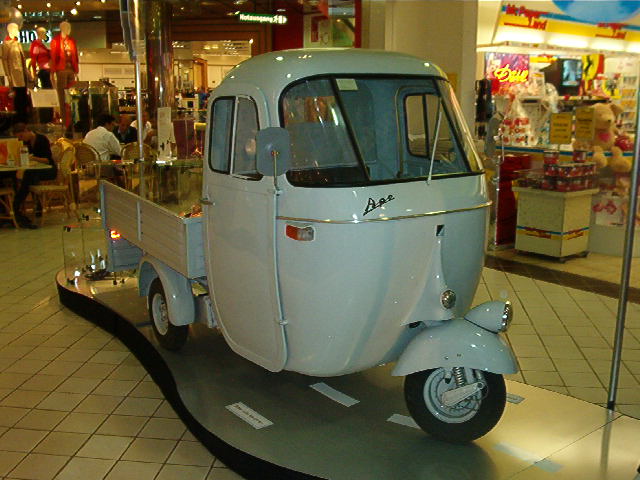
Piaggio Ape C on display in a US shopping mall car-show exhibit

The 1956 Piaggio Ape C boasted such luxuries as an optional enclosed cab with a full frontal cowling standard, it had a full-width driver's seat allowing room for a passenger, and the 150cc 2-stroke single with optional electric starter was located under the driver's seat. The virtually identical Ape D, sold concurrently for three years, arrived in 1964 with a 175cc two-stroke single, a heated cab on closed models and a front fender-mounted headlamp; it was updated further into the Ape MP (Motore Posteriore, meaning rear-engine), with a rear-mounted engine for reasons of comfort and weight distribution, and a version called the Pentaro, basically a cab and chassis Ape fitted with a semi-trailer, was available from 1960 to 1968.

"Wedge" Ape MP


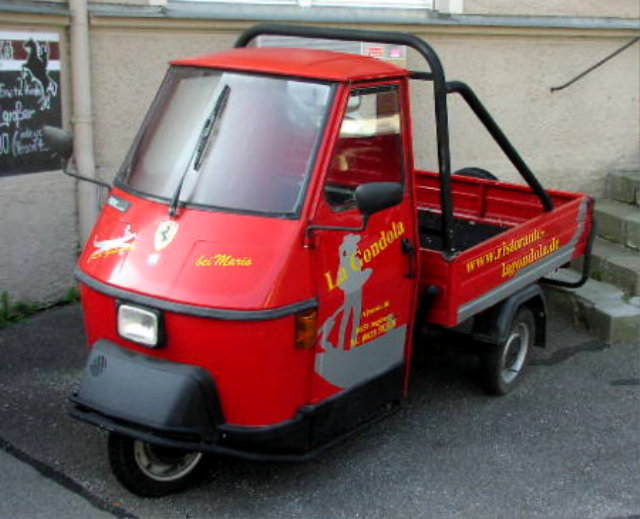
All rear-engined Apes were restyled to the then-popular "wedge" look in 1981, with the standard model "TM" featuring a 218cc petrol or 422cc diesel engine and choice of a steering wheel or handlebars for the first time. By the 1990s, styling on all models was refreshed a bit, a 49.8cc model was available under "voiturette" policy in France for those without driving licenses or for those desiring a low-speed vehicle elsewhere, four-wheel versions were available, and 49.8cc vans could be had.

Ape Calessino on the floor at the Milan Motorcycle Show


In 2006, Piaggio introduced the retro Ape Classic, bringing the look of the 1960s' Ape C and D back along with production in India and a 422cc Lombardini diesel engine on Indian-built Apes. The luxurious and colorful Calessino autorickshaw concept car shown at the 2007 Milan Motorcycle Show proves that the Ape can be fun as well as practical, and shows the retro style of the Ape Classic very nicely.

 At some point, Bajaj, Mahindra & Mahindra, and several other companies in Third World countries copied the design of the mid-engine and early rear-engine Ape for use as the "Tuk-Tuk" autorickshaw used as public transit in the Third World, while also making Ape copies in truck and van form for workmen. These are nearly as familiar to the world at large as the Philippines' Jeepneys, and now Tuk-Tuks are made in the USA and exported globally

Sunday, February 3, 2013

Forbidden Fruit: 1990 Mazda Carol Kei Car


This kei car may be the only one of its kind in North America, and at $1750 CDN, with 86,000 kilometers, it seems like a great deal for those who can legally import a 1990 car or who live in Canada. The automatic transmission/660cc engine may make it sluggish however.

Find it here in Vancouver, British Columbia for $1750 CDN

Monday, January 21, 2013

Please Save Me: 1960 Bedford CA Dormobile Project


Bedford CA vans are a rare sight in North America, but here is the very rare Martin Walter Dormobile camper conversion in need of restoration. It has a decent body for a rust-belt vehicle, but needs a total restoration, is missing its bumpers and other things, needs a new pop-top fiberglass piece & canopy made, and the upside is that parts are easy to find in the UK and even service for the camper conversion parts can be had or assisted with via the UK.

It will be a tough project, and it is smaller than a VW bus, but this will be a great way to enjoy the 24 Hours of LeMons, ChumpCar, local oval-track, vintage races, or other auto races, in comfort, if there is a place to park it, and would make an ideal swap-meet rig.

Find it here in Mohawk, New York for $2000 USD or offer, despite the eBay category it's in, there are ways to title it, or alternatively it could be broken up to save other CAs and Dormobiles.

Forbidden Fruit: 1965 Piaggio Ape Project in Canada


The Piaggio Ape (pronounced ah-pay), made by the company most famous for the Vespa scooter, is not well-known in North America, but is ubiquitous in the Mediterranean and the Third World as an inexpensive working vehicle. This Ape has an unknown streamliner cargo bed and has been stored for many years, but is a great project, and can be imported to the US easily. Parts may be tricky (as with many other interesting vehicles), but eBay is a great source, and this enthusiast website is a great source of info on these interesting microtrucks. 

An advantage that the Ape has over a kei truck is that in places where all kei trucks regardless of model year are illegal, the Ape isn't, since it is legally considered a motorcycle. Most states also do not require a motorcycle endorsement for three-wheelers. 

Daihatsu Midget fans in states that say no to kei trucks, the Piaggio Ape (especially in closed-cab form) is for you!

Find it here for $1000 CDN in Coquitlam, British Columbia (or go here if ad disappears)