
(all pictures from Wikimedia Commons)
Let's reflect on the years immediately after World War II. While the US and British Commonwealth had their own domestic or locally-assembled light trucks along with countless surplus US military Jeeps, much of the rest of the world relied on horse and wagon or pushcart to conduct business on the ravaged streets of the European continent and the then largely nonmotorized areas of sub-Saharan Africa, the Indian subcontinent and Southeast Asia. Former aircraft manufacturer turned motorcycle maker Piaggio, of Pontadera, Italy, came up with the idea of adding a two-wheeled rear axle, extended chassis and wooden cargo bed to their popular Vespa motorscooter for use in commerce as well as in the postwar reconstruction of Italy.
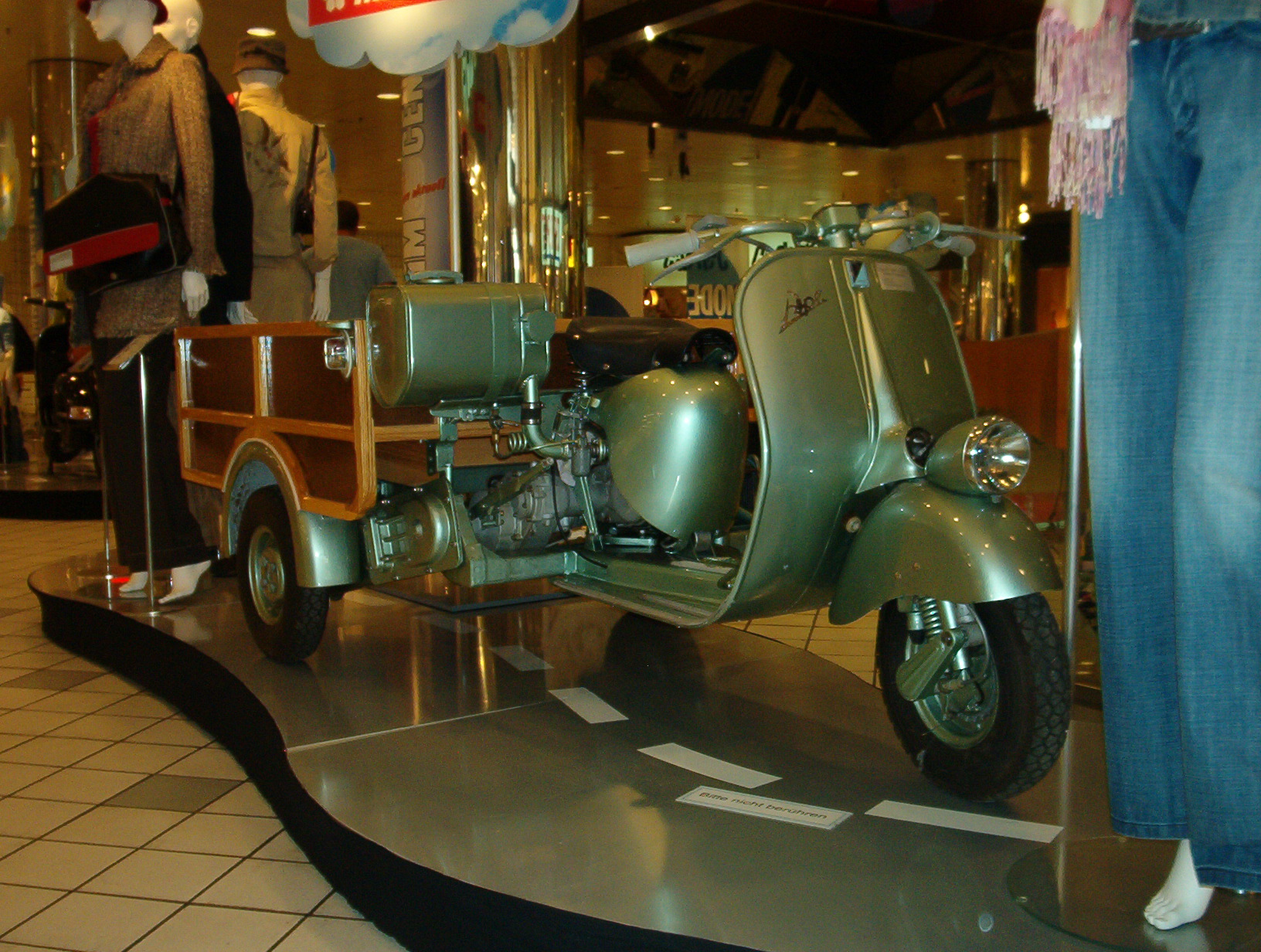 |
| An immaculately restored Ape A |
By 1952, the Ape B boasted a 150cc engine, pressed steel cargo bed, and cable-operated gearchange. Styling changed negligibly until the completely new Ape C arrived four years later.
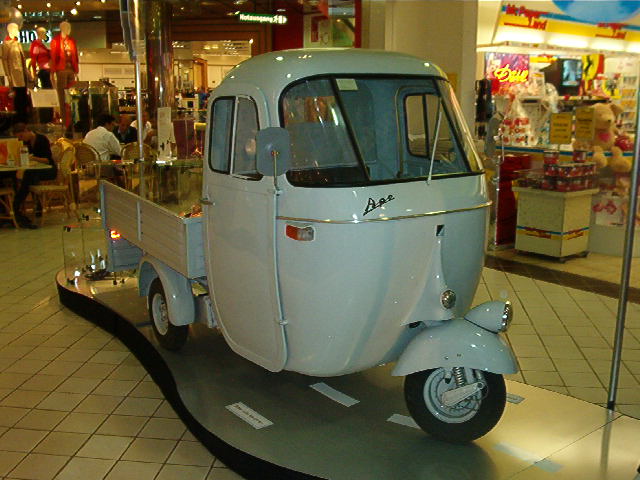 |
| Piaggio Ape C on display in a US shopping mall car-show exhibit |
The 1956 Piaggio Ape C boasted such luxuries as an optional enclosed cab with a full frontal cowling standard, it had a full-width driver's seat allowing room for a passenger, and the 150cc 2-stroke single with optional electric starter was located under the driver's seat. The virtually identical Ape D, sold concurrently for three years, arrived in 1964 with a 175cc two-stroke single, a heated cab on closed models and a front fender-mounted headlamp; it was updated further into the Ape MP (Motore Posteriore, meaning rear-engine), with a rear-mounted engine for reasons of comfort and weight distribution, and a version called the Pentaro, basically a cab and chassis Ape fitted with a semi-trailer, was available from 1960 to 1968.
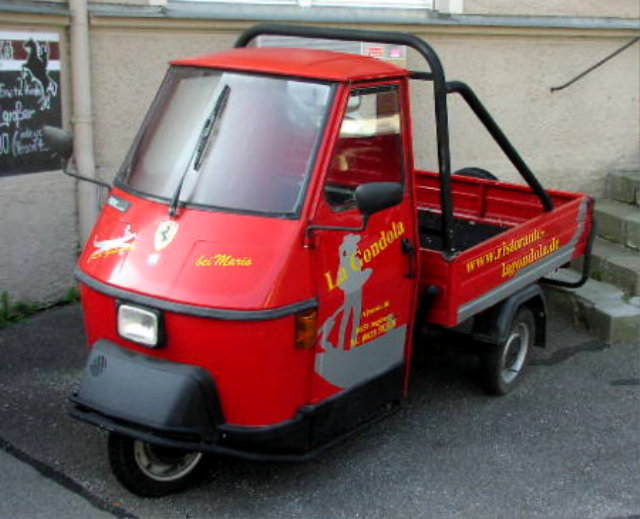 |
| "Wedge" Ape MP |
All rear-engined Apes were restyled to the then-popular "wedge" look in 1981, with the standard model "TM" featuring a 218cc petrol or 422cc diesel engine and choice of a steering wheel or handlebars for the first time. By the 1990s, styling on all models was refreshed a bit, a 49.8cc model was available under "voiturette" policy in France for those without driving licenses or for those desiring a low-speed vehicle elsewhere, four-wheel versions were available, and 49.8cc vans could be had.
 |
| Ape Calessino on the floor at the Milan Motorcycle Show |
In 2006, Piaggio introduced the retro Ape Classic, bringing the look of the 1960s' Ape C and D back along with production in India and a 422cc Lombardini diesel engine on Indian-built Apes. The luxurious and colorful Calessino autorickshaw concept car shown at the 2007 Milan Motorcycle Show proves that the Ape can be fun as well as practical, and shows the retro style of the Ape Classic very nicely.
At some point, Bajaj, Mahindra & Mahindra, and several other companies in Third World countries copied the design of the mid-engine and early rear-engine Ape for use as the "Tuk-Tuk" autorickshaw used as public transit in the Third World, while also making Ape copies in truck and van form for workmen. These are nearly as familiar to the world at large as the Philippines' Jeepneys, and now Tuk-Tuks are made in the USA and exported globally.


