Showing posts with label coachbuilt. Show all posts

Monday, April 29, 2013

College Cars: 1933 Lincoln KB Custom Dietrich Convertible Sedan

This is College Cars, a recurring feature about the vehicles of the Academy of Art University car collection. Today we look at this 1933 Lincoln KB, a factory special-order convertible sedan bodied by Dietrich. Fifteen of these cars were built in 1933; only six survive today.


In the 1930s, Lincoln had a catalog that allowed its wealthy clientele to select custom bodies from a variety of coachbuilders. Among these was Dietrich. The KB featured a complex L-head V12 engine displacing 448 cubic inches, good for 150 horsepower.

Sunday, April 21, 2013

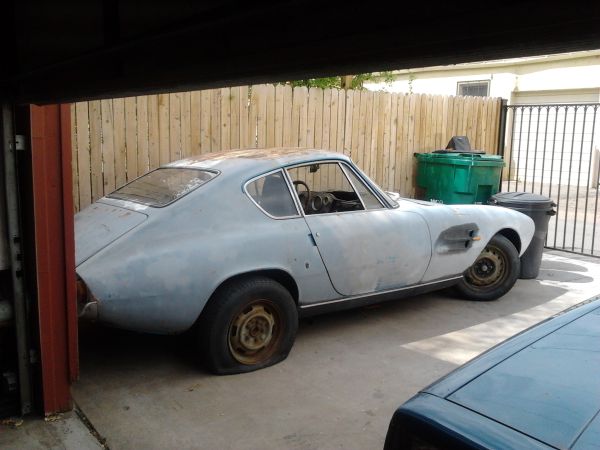
Cobra Lite: Ford V8-Swapped 1966 Ghia Fiat 1500GT


For possibly less than the price of building a crappy replica of a Shelby Cobra 427S/C with no provenance and no weather protection or turning a Datsun Z-car into a Chevy V8-powered wannabe Ferrari 250GTO, you can have a real Italian exotic car with full weather protection, provision for effective air conditioning via bulkhead-mounted or "short pack"Vintage Air climate controls, American small-block V8 power and styling remarkably similar to that of a Cobra with a fastback (or the related AC Aceca), many parts available (stocked or special-order) from Bayless FiatC. Obert & Co. (Fiat Plus) and Re-Originals, and all the hard work has been done by the seller as far as the bodywork and conversion to a Ford 289 small-block, C4 automatic (can and should be swapped for a 4- or 5-speed manual) and 8-inch Ford rear axle go, but it needs some trim, all interior, all engine details, and general finishing work to finish.

Find it here in Denver, Colorado with no price listed.

Monday, April 1, 2013

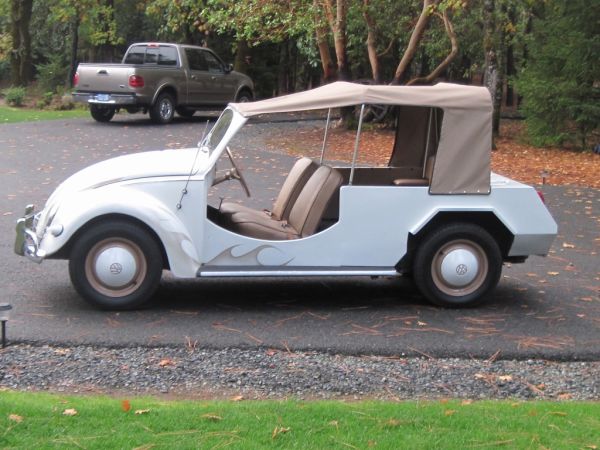
German Jolly: 1957 Volkswagen Beetle Beach Cruiser


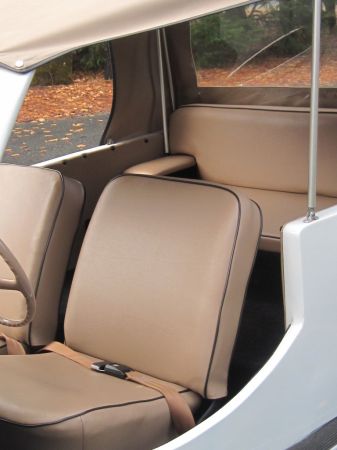
This 1957 Volkswagen Beetle is a custom job supposedly done "many years ago"; while the Fiat Jolly and Renault 4CV Jolly are not mentioned in the ad, they appear to be a definite inspiration for this car, and this would more than satisfy any desires for a fun oddball summer car among staff of this site.

It has no rust, a good top and interior, a desirable period aftermarket petrol gauge that replaces the stock fuel reserve, everything is functional, and the 40-horsepower flat-four (with later Karmann Ghia air cleaner) and the transmission shifts smoothly. If it is as described and built well, this car is a great deal at $4500, which would not even get you in the front door for a rusty or incomplete Jolly project, and unlike a Jolly, is not so rare and valuable that it couldn't be used regularly. The availability of VW parts and service also makes it a desirable Jolly alternative, and the rear seat space, full wheelbase and roadability make it a great alternative to a fiberglass street buggy.

Find it here for $4500 in Grants Pass, Oregon

Monday, March 25, 2013

College Cars: 1938 Talbot-Lago T150-C Speciale

This is College Cars, a recurring feature on the auto collection of the Academy of Art University in San Francisco, CA. Today we look at this 1938 Talbot-Lago T150-C Speciale, a best-in-class Pebble Beach Concours winner.


This is the only long-wheelbase T150 'Lago Speciale' believed to have been built out of 16 cars in this series bodied by Figoni & Falaschi. It has an interesting history - originally commissioned by a French banker, a later owner raced the car at the 1948 24 Hours of Spa. He won first in class. The car received a restoration many years later and in 2011 won First in Class and was nominated for Best in Show at the Pebble Beach Concours d'Elegance. This is a truly amazing car, and is valued accordingly. The Academy of Art University picked it up in 2010 for a mere $4,620,000.

Saturday, March 2, 2013

American Muscle, Italian Style: Iso-Rivolta Grifo


Early Grifo at speed, pic from Wikimedia Commons

In the early 1960s, Iso-Rivolta SpA of Bresso, Italy was already famous for its sleek, Chevrolet Corvette-powered IR300 grand tourer, and company founder/president Renzo Rivolta wanted a followup to the IR300. The sleek fastback Grand Tourer that resulted was the work of famous automotive engineer Giotto Bizzarrini, late of Ferrari, and young hotshot designer Giorgetto Giugiaro at Carrozzeria Bertone. Also powered by a Chevrolet Corvette V8, and having a clean-sheet chassis design, this was an elegant yet potent exotic car that was mostly built by hand and received rave reviews. 17 targa-top versions were built, with the remainder of the 413 Grifos produced from 1963-74 being coupes.

The car developed 390 horsepower (290 kilowatts) in its stock form, and was not a small car at its length of 174.4 inches (4,430 millimeters). Transmission availability included 4-speed Muncie and 5-speed ZF manuals, or 3-speed automatic on special order. Over the years, engine availability included the Chevrolet Corvette 5.4-liter V8, Ford "Cleveland"5.7-liter V8, and 7-liter and 7.4-liter Chevrolet V8s, all sourced in the US but totally reworked and blueprinted at the factory.

The Grifo's interior featured incredible luxury and comfort along with style, and build quality was top-notch. Variations of the Grifo chassis were used under the Fidia sedan and Lele 2+2 coupe, offering spirited handling and a comfortable ride.

In 1970, the Grifo lost some of its elegant style and cachet with a then-stylish droop snoot nose and hideaway headlights, and got an execrable bonnet scoop, then went away in 1974 with the remainder of Iso-Rivolta's car range.

Lesney-Matchbox produced a UK-market Grifo in small-scale in the late 60s, which was a staple in toyboxes worldwide for years, and the one in the author's collection has some wear and tear plus some detailing.


End Of The Glory Days: 1961-68 Alfa Romeo 2600 Coachbuilt Variants

Alfa Romeo 2600 Spider, pic from Wikimedia Commons


With the shift toward only economy car production after World War II at an end and economy car production shifted toward the Giulietta range, fabled Italian marque Alfa Romeo, once known for its grand 6C and 8C luxury and racing cars but then making a handful of variants of one basic design, needed a new flagship. They started with a factory-designed/built sedan, Bertone coupe and Touring Superleggera spider, based on the decade-old 1900 sedan underpinnings, but quickly realized that those were unsuited to moving the heavy bodies and the passengers along autostradas and Alpine roads swiftly. This article focuses on the coachbuilt models: the Touring spider, Bertone Sprint and Zagato coupes, and the OSI Berlina deLuxe.

In 1961, Alfa Romeo restyled the cars, mainly with bonnet scoop changes and trim changes, but most significantly as far as cosmetics go, an extended nose. The biggest change was in the alloy-block, 2600cc twincam straight-six, which harkened back to the good old days of the 6C2500, and offered decent performance considering the weight and aged chassis of the cars, but negatively affected stability.

All coachbuilt 2600s featured triple sidedraft carburetors, 5-speed manual transmissions, VDO windshield washers, tachometers and other things typical of an exotic car in the 60s as standard equipment, but where the Touring Spider shared many elements and some parts with the Maserati and Lancia coupes whose bodies were being assembled in the same factory, the 2600 Sprint shared a great deal with the concurrent BMW 3200GT and Iso-Rivolta GT, but looked like an enlarged Giulia Sprint GT. The 2600SZ (Sprint Zagato) and OSI Berlina deLuxe looked like no other car on the global market in the 1960s.

Eventually high costs of coachbuilding, aging tooling and designs, and the rather frumpy factory-bodied sedan's low sales, led to the 2600's discontinuation. The bankruptcies of OSI and Touring Superleggera at roughly the same time couldn't have helped much either. Its belated replacement, the Alfa 6, was a controversial extended-wheelbase Alfetta sedan that was neither attractive nor popular.

Today, as collector cars, the 2600 Spider, Berlina deLuxe and 2600SZ are increasingly popular, with the spider bearing as much cachet and image as a contemporary Ferrari roadster at a fraction of the price, the 2600SZ being valuable but controversial as all Zagato creations are, and the Berlina deLuxe remaining undervalued and undersupported on the restoration-parts front. The 2600 Sprint is worth somewhat less, and most 2600 sedans have been stripped for parts and junked long ago.

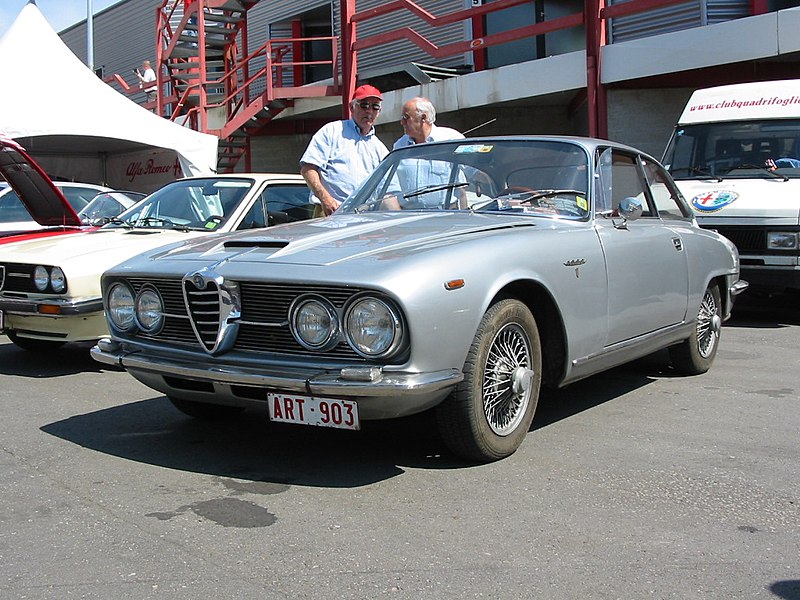
2600 Sprint in silver with factory Borrani wire wheels, photo from Wikimedia Commons


The elegant and thoroughly modern OSI Berlina deLuxe. Photo from Wikimedia Commons


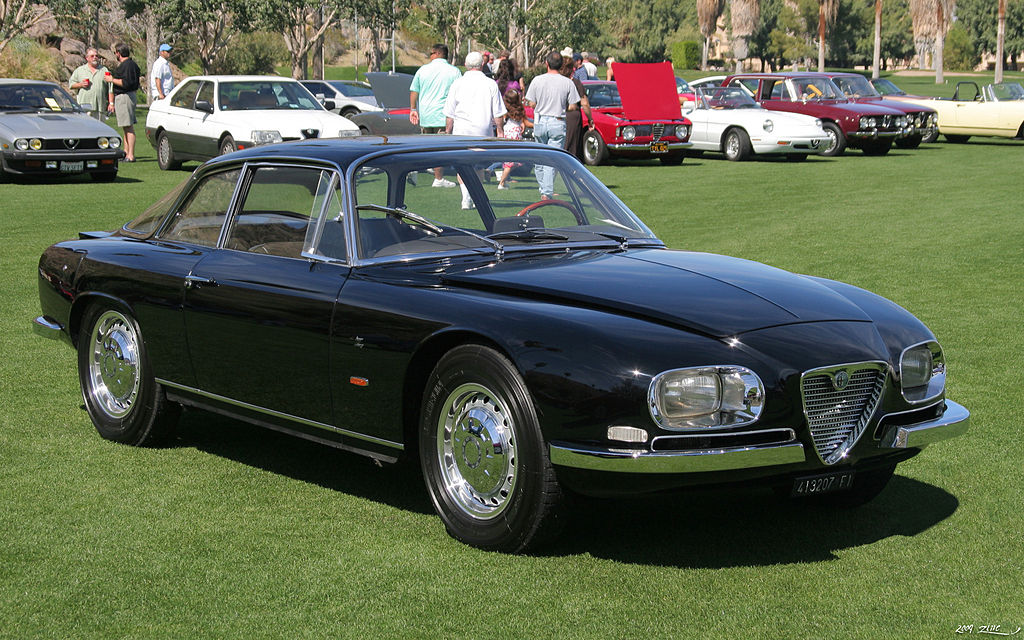
Stunning black 2600SZ


And here is the nicely crafted, affordable 1/24 scale diecast model by Welly.


Monday, February 18, 2013

Low Price, Low Lights: 1958 Volkswagen Karmann Ghia Coupe


The early Karmann Ghia, known to enthusiasts as a "lowlight", is a scarce find, especially at this price.  It needs an engine and a full restoration, but all of that is easily accomplished due to the abundance of reproduction parts. Being a prairie car, it will have little rust compared to Great Lakes and Northeastern cars, and the car has unknown paperwork (presumably a title) included.

Auction only has 18 hours left at the time of writing, but knowing the eBay Salvage & Parts Cars section and the lowlight Ghia's desirability, it will most likely be relisted.

Find it here in Omaha, Nebraska, on eBay, with bids starting at $1575 USD

Sunday, January 13, 2013

Diecast Review: 1/24 scale Welly Diecasting 1960 Alfa Romeo 2600 Spider

Beautiful lines that capture the 1/1 subject's elegant body style, more reminiscent of an Iso Rivolta or a Lancia than of an Alfa Romeo, befitting its role in the 1960s sports car market

Front-end details are spot-on, "googly eyes" produced by light mounting lugs are less present

Beautiful front-end design, slightly spoiled by bonnet (hood) and lower-body air intakes being tampos instead of cast-in details. Side lights are especially well-done.

Other than odd bumper angle, rear end is well-done.


Mouth-watering side elevation, hubcap, wheel, Carrozzeria Touring badge and trim are well-done, but bumper could stand a better placement.

Rear deck is beautiful and well-executed, down to the folded and booted convertible top, top boot snaps, twin petrol fillers and small mystery trim piece.

Altogether executed well, even the "two-crush-two" seating typical of Touring and Vignale sporty cars in the 60s is perfect.

Interior is outstanding, but came from the factory a bit dusty. Gauges, switchgear, steering wheel, seating and dashboard are well-executed, even an ashtray is included.

Industry-leading detail in the dash and center tunnel. Even the quirky grab handle & cantilevered rear-view mirror are well-done, and a legible gold Alfa logo is visible on the steering wheel.

This casting is not recommended in red, especially with the top up, white suits its luxo-sport genre nicely and the nonremovable up-top may obscure the wealth of interior detail. Build quality/fit & finish is a 6 out of 10 (bad door gaps on passenger door, came out of the box very dusty, bad rear-bumper fit, and I had to use Testor's model glue to permanently attach all 4 hubcaps, but solidly built otherwise), detail is an 8.5 out of 10 (chassis is minimalistic, engine is literally two colors with little color and part detail, and the boot does not open, but it is great for a $15-20 price range casting), visual impact is 10 out of 10 and subject matter is a 10 out of 10, since no scale subjects of the 2600 Spider beyond a Protar 1/24 model kit from 1993 or so and a handful of cottage-industry 1/43s existed until Welly cast this up in late 2012. A 1/18 version was planned, but cancelled in the end.

Conclusion: Highly recommended.